19 January 2026
Make it clear
Why clarity scales growth
This is the first article in a three-part series on how business owners can grow and scale through connection and strategic communication. We'll explore the frameworks that turn strategic thinking into business results: clarity through brand positioning, reach through campaign design, and retention through customer experience.


You know your business inside out. But here's the problem: your customers don't. And it's not because they're not paying attention. It's because you're not making it easy enough for them to understand.
When your positioning is unclear, people can't quickly grasp what you do, who you're for, or why they should choose you. They scroll past. They book calls with competitors. The cost shows up in endless explaining, frustrated teams working on messaging that doesn't land, and knowing your business is good but the market can't see it.
Clarity is the difference between being overlooked and being obvious.
It's about making your value so unmistakable that people understand it in seconds, remember it easily, and trust it instinctively. When clarity is in place, decisions speed up, teams align faster, and customers feel confident they've found the right partner.
Clarity isn't flair. It's focus. And focus is what scales growth.
The real problem isn't what you think it is
On the surface, it looks like mixed messages and inconsistent branding. Your sales team says one thing. Your website says another. Leadership tells a third story in investor decks. It feels like herding cats.
But the deeper problem is this: you've grown in capability without growing in coherence.
New services get added. Teams shift. Market pressures change your positioning bit by bit until people start making up their own version of the story. Suddenly, your brand isn't one thing anymore. It's ten things. Or twenty.
Externally, this shows up as confusion. Prospects don't get what makes you different. Sales cycles drag. Trust takes longer to build because every touchpoint feels disconnected.
Internally, it's worse. Teams debate the same foundational questions in every project. Marketing rewrites copy from scratch. New hires take months to understand what you actually stand for.
The result? You're working twice as hard to get half the traction. Not because your offer isn't strong. But because the signal is too weak to cut through.
What changes when you get clear
When your positioning is sharp, something shifts.
Internally, decisions get faster. There's less debate, less rework, less "let me just check with leadership on how we're saying this now." Your team has a shared language they can lean on — a set of agreed messages, a clear structure, a single source of truth. That alone saves hours every week.
Externally, people understand you better. They grasp your promise in one read. They recognise you when they see you again. They start to trust you because the message is consistent every time they encounter it — whether that's on your website, in a proposal, at an event, or in a follow-up email.
Consistency becomes your competitive advantage.
Your message earns recall. Recall earns trust. Trust earns results.
A framework for positioning that actually works
Clarity doesn't happen by accident. It's the result of a deliberate process that moves from leadership alignment to practical, ready-to-use assets.
At KRAFT designsmiths®, we guide you through strategic brand positioning using a framework that's structured, collaborative, and built to deliver outcomes you can use immediately.
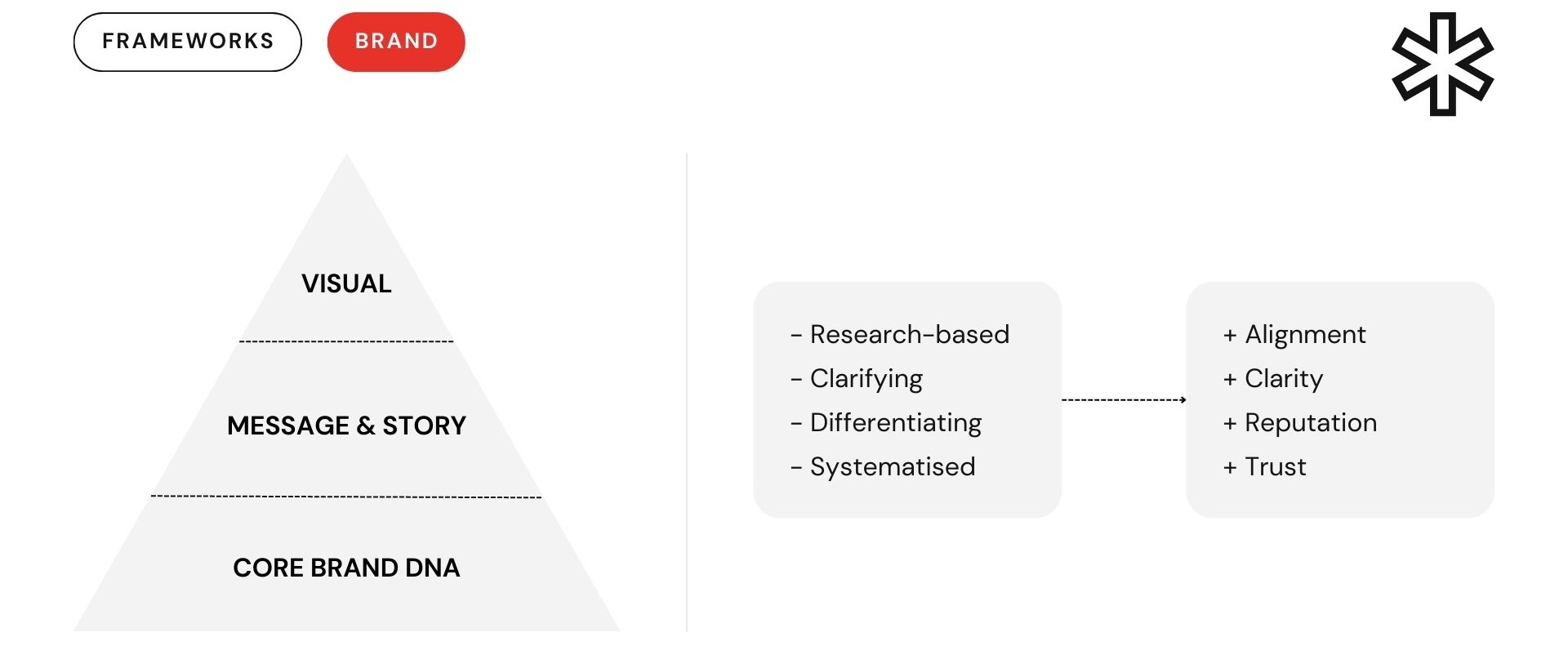
Align on core brand DNA
This is where we get clear on the essentials — the backbone that everything else builds from. We align leadership on purpose (why you exist), values (how you operate), vision (where you're headed), personality (how you sound and feel), and proof (what makes you credible).
When these are explicit and agreed, you stop rewriting them in every deck. You stop second-guessing them in every campaign. And you make it easier for new people to step into the culture and understand what's expected.
Clarify your messaging
From that foundation, we shape one positioning sentence and a simple messaging architecture. The positioning explains your value and difference in a single line. The messaging breaks that into a small set of pillars — each with proof points, examples, and language your team can reuse across sales, web, social, and PR.
This structure is deliberately constrained. Fewer messages create stronger memory. And it gives your people modular blocks they can pull from with confidence, instead of reinventing the story every time.
Design your visual identity
Language and design must work together. We codify a visual system that's legible, distinctive, and scalable: logo suite, colour, type, layout rules, and real-world applications. The goal isn't decoration. It's recognition. Consistent visuals reduce cognitive load so the message lands faster and sticks longer.
Create your single source of truth
All of this — the positioning, the messaging, the visuals — lives in one place your team can copy from with confidence. That single source protects quality, cuts rework, and shortens time-to-publish. It's the practical heartbeat of clarity.
Five steps to get started (that span the whole framework)
You don't need a six-month project to start. You need focus, honesty, and a willingness to make decisions. Here's how to move from where you are now to a position of real clarity — step by step, from purpose all the way to visual identity.
1. Lock down your brand DNA on a single page
Start with the foundations. Get your leadership team in a room (or on a call) and agree on purpose, values, vision, personality, and three proofs of credibility. Write them down. Don't overthink it. Don't make it poetic. Just make it clear.
This is your backbone, not a brochure. When it's done, you'll feel meetings speed up because you're no longer re-debating what the company stands for.
2. Write one positioning sentence and get everyone to sign off
For [audience], we solve [problem] by [how you do it], so they get [outcome]. If it doesn't fit in one sentence, it's not ready. Share it with your leadership team. Read it out loud. Ask: does this sound like us? Does it land? If yes, decide. Don't wordsmith for weeks. Decide and move on.
3. Build three to four messaging pillars with proof
Now take that positioning and break it into three to four core messages — each one anchored in a real customer need. Under each pillar, add brief proof points and a few example lines: one for your website, one for a sales email, one for a social post.
You're not chasing perfection. You're testing tone and relevance. Read them out loud. If they sound stiff or corporate, simplify. If they feel disconnected from how you actually talk, rewrite them in your own words.
4. Standardise how you look
Create a lightweight style kit with logo files, colour codes, type choices, spacing rules, and a few layout examples. Then replace every ad-hoc asset in your Google Drive with templates. Consistency beats novelty every time. Your goal is recognition, not surprise.
When your visuals are predictable in the best way, people start to remember you. And memory is the first step to trust.
5. Test it in the real world and refine what doesn't land
Put your new positioning and messaging in front of five customers and five prospects. Ask four questions:
- - What do you think we do?
- - What stands out to you?
- - What's missing or unclear?
- - What would make you take action?
Listen carefully. Update your single source of truth based on what you hear. Remove what people ignore. Keep what they repeat back to you. This is how you move from theory to traction.
The result: recognised, trusted, ready to grow
When this system is in place, your brand becomes the asset it's supposed to be.
Leaders stop re-debating the fundamentals. Teams communicate consistently without needing permission every time. Customers understand you faster and buy with confidence. Sales cycles shorten because you're no longer spending half the conversation just explaining who you are.
Every channel works harder because it's saying the same strong thing in a clear, coherent way. And your team can finally focus on doing great work instead of constantly clarifying what that work is supposed to mean.
What comes next: turning clarity into reach
Once you've built a clear brand position, the next challenge is reaching the right people with the right message. That's where campaign design comes in. In the next article in this series, we'll explore how to move beyond activity and build campaigns that connect, convert, and scale.
Ready to make it real?
If you want to apply this level of clarity across your whole organisation, we can help you align leadership, codify your messaging, and build the visual system and single source of truth that makes consistency effortless.
Get in touch with the KRAFT team today.
Is your brand communicating on behalf of your business?
Whatever industry you’re in, your brand is speaking on behalf of your business. Don’t allow your voice to be drowned out by the slew of competitors also vying for audience attention. Become an industry leader by designing an integrated brand and communicating through a clear and consistent message structure. Let us craft your next steps.
Work with us